


Vale do São Francisco: Where Tropics Meet Terroir


Brazil’s wine story unfolds far from the expected clichés of cachaça and carnival. With a wine history spanning nearly 500 years, it has quietly established itself as South America’s third-largest wine producer by vineyard area—after Argentina and Chile—with exports reaching over 50 countries. While wine consumption remains modest (under 2 liters per capita vs. France’s 41.5 or the U.S.’s 11.8 in 2024), the nation’s wine narrative reflects its broader complexity: a confluence of immigrant traditions, from Japanese to Italian, now aided by domestic and international investment.
Today, Brazil’s viticultural map extends across most of the country’s 26 states, with consecutive years of vineyard expansion placing it among the world’s top 20 producers. While Rio Grande do Sul’s temperate southern latitudes remain the production heartland, our focus turns northeast to Vale do São Francisco. Here, in Brazil’s tropical interior, everything you think you know about where grapes can grow gets turned on its head.
Tropical Terroir

Just over 600 miles from the equator, Vale do São Francisco straddles two distinct Brazils: Bahia, the cradle of Afro-Brazilian culture and a likely birthplace of samba and capoeira, and Pernambuco, with its Atlantic ports and industrial pulse. At 8–9°S latitude, the region sees barely 400 mm of rain annually—erratic yet intense showers between November and March, followed by months of drought. “The exact timing varies, influenced by the El Niño and La Niña climate phenomena. This year we had a more prolonged colder season. Colder in our terms, of course: from 19–20°C/66–68°F to 28–29°C/82–84°F,” explains Paula Theotonio, the region’s star sommelier and communicator, and owner of Oxe Vinhos wine shop and bar.
The mighty São Francisco River—Brazil’s great artery that covers 8% of the national territory—and the vast Sobradinho Reservoir make the impossible possible through irrigation. Government initiatives in the mid-1980s established drip-irrigated vineyards along the riverbanks, bringing new industry to the developing Northeast. Today’s 10,000 hectares mostly yield table grapes and juice; just over 1,200 acres (500 hectares) of Vitis vinifera are authorized for fine wine production—a fraction that’s redefining what’s possible in the very tropics.
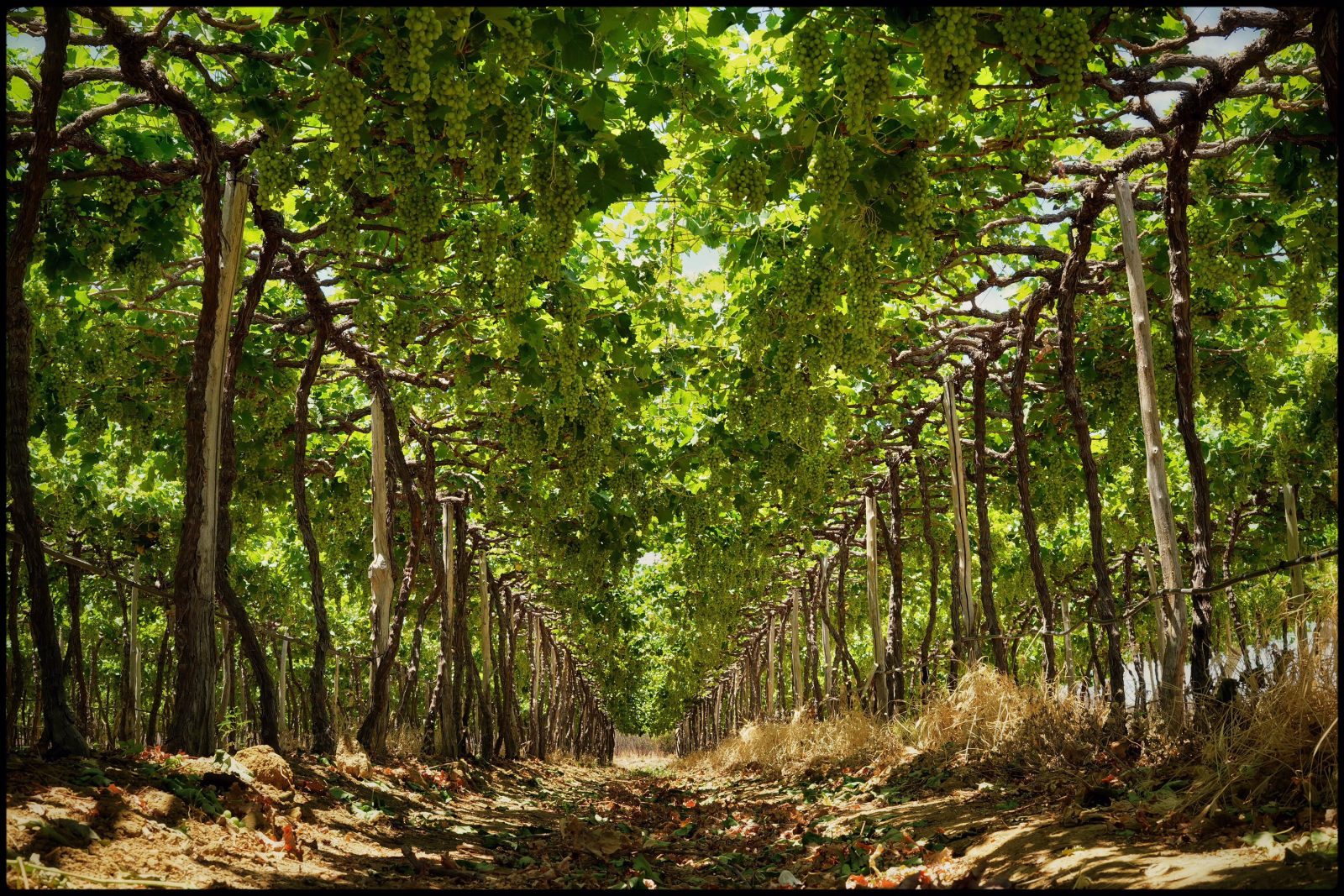
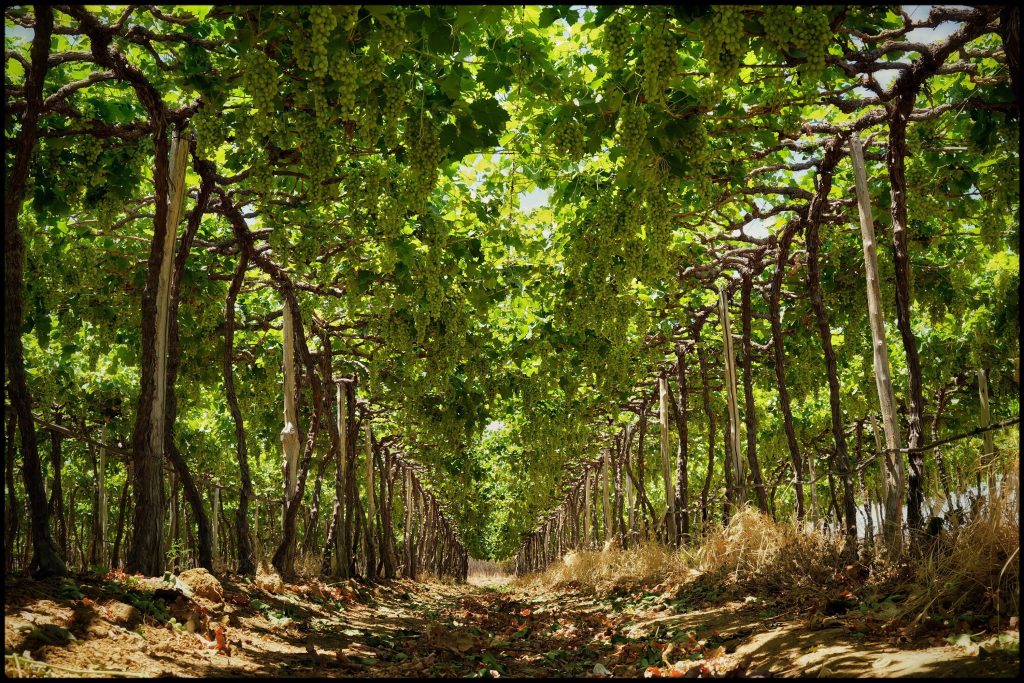
This close to the equator, winter exists only on the calendar. The sun beats down 300 days a year across the arid swathes of Caatinga shrubland, keeping the thermometer steady at 26°C/79°F. Without seasonal cues, vines default to perpetual summer, capable of producing fruit year-round. Growers impose dormancy through calculated drought, controlled irrigation cycles, and growth regulators to prevent exhaustion and maintain concentration. Each variety ripens on its own schedule, typically 100 to 150 days from pruning to harvest.
Walking the vineyards, it’s everything everywhere all at once: one plot heavy with fruit while its neighbor stands bare, another just unfurling green shoots. “There are no slow months for me,” laughs Eloiza Teixeira, winemaker at Brazilian giant Miolo, surveying vines that yield up to 40 tons per hectare under pergola training. This is precision agriculture meets tropical abundance, where timing isn’t dictated by seasons but by spreadsheets and irrigation schedules—and harvests are routinely limited to two per year to achieve the best expression.
Grapes Under the Equatorial Sun

Miolo’s Terranova winery is one of the handful of major players in Vale do São Francisco shaping the region’s identity, and one of nine wineries registered under the Indicação de Procedência Vale do São Francisco, the world’s first appellation for tropical wines. Brazilian appellations require direct producer organization through bodies like VINHOVASF, the regional wine institute leading this particular charge.
Terranova is a true sparkling powerhouse, betting everything on the style that put the region on the map. The Moscato family varieties—particularly Moscato Canelli and Moscato Itália—deliver the aromatic exuberance these tropical sparklers are known for, mostly Charmat-method with some residual sugar. The sweetness plays well domestically and pairs naturally with the Northeast’s fruit bounty—from mangoes and bananas to sweet-tart umbu or cashew fruit—and local specialties like steaming moqueca fish stew.
The region’s drier sparkling bottlings build on Sauvignon Blanc, Verdejo, and Chenin Blanc—the latter a “patrimonial grape” here, planted in the 1980s and prized for its bright acidity, reliable productivity, and resistance to disease and wind. Add Arinto, Viognier, Chardonnay, Portuguese Fernão Pires, and workhorse Colombard (planted but not registered), and you have the blueprint for the still-white version of vinhos do sol: the so-called “sunshine wines” with a fruit-forward, light-hearted personality.
Turning to reds, Cabernet Sauvignon rules here, with the oldest vines approaching 40 years, and Syrah close on its heels. The mix also includes warm-loving Iberian varieties like Tempranillo and Touriga Nacional, plus an international lineup of Barbera, Tannat, Merlot, and even Egiodola—a tannic French cross of Fer Servadou with Abouriou. Rio Sol winery (part of Portugal’s Global Wines group, headquartered in Dão) has skillfully tamed this challenging variety into something rather compelling with its Rio Sol Gran Reserva Egiodola release.
“Malbec is certainly gaining its place,” says Euclides Neto, enologist, Master in Wine Tourism, executive secretary of VINHOVASF, and one of the architects of the region’s wine tourism push. Several producers are betting on Malbec’s seductive fruit profile and velvety texture, particularly Garziera of the pioneering Verano Brasil group, whose award-winning Reserva Malbec impressed on my visit—with more promising releases in the pipeline.
Uncorking the Future

Looking ahead, what’s the endgame for this tropical wine frontier? I asked two Brazil-based wine pros to weigh in on Vale do São Francisco’s potential.
“As a region, it’s the only one I see that, within a few decades, with proper investment and development, could build substantial export volumes,” offers Júlio César Kunz, a renowned wine educator and president of the Rio Grande do Sul section of the Brazilian Sommeliers Association. “Particularly the easy-drinking, fresh and fruity reds, and the entry-level sparkling.”
“Brazilian vintners are learning to understand our own grapes better. They’re tasting wines from all over the world—good and bad—and discovering our identity,” observes Lucia Porto, wine journalist and founding partner of Brasil de Vinhos, Brazil’s only media platform dedicated to domestic wine. “Many now understand we don’t need to make wines like the French, Portuguese, or Italians. You can imagine something new, but you cannot taste it yet in your mind—the bottle is still being filled.”